Friday, 28 June 2013

Font size. Such an easy starting point to reduce barriers to reading. Critical Print Size

Font size.  Such an easy starting point to reduce barriers to reading. Critical Print Size

Yesterday I met the daughter of a friend who I taught with years ago. She always had difficulties in school, which were ‘diagnosed’ as Dyslexia when she went to the local FE College.

No one at school suggested that she may have a barrier to reading that could be reduced or removed.

The conversation which took place went over her experiences as a person growing up with dyslexia and how she was ‘assisted’.

She recounted how her difficulties got worse when she started in secondary school.  The drop in font size was a real problem for her. So much so that at the age of 12 she went to an optician where she was identified as significantly short sighted with an astigmatism in both eyes.

In secondary school, she did not like practical work which involved reading instructions or writing. She was very messy or clumsy if she mixed the practical work with reading and writing. This is a very typical story that I hear from adult dyslexic people.  Where possible she would work in a team and leave the reading and writing to other members of the team…. No problems then.

This did not solve her problem though.  In a way it must have reinforced in her the idea that she just was not really academic. The optician could not fix her problem.   She was still very aware that the reading was really limited by the small font sizes being offered to her, in all the books and print outs.

With smaller fonts the letters seemed to crowd each other, especially the ends of the words, which she would guess at. After a short period of slow reading the letters and lines would start to move, become unstable.

At the FE College, she was referred to an Educational Psychologist, who duly tested her and pronounced her ‘dyslexic’. Unfortunately, she was unable to read the ‘report’ and did not understand the ideas when explained to her.  This is a common experience of dyslexic undergraduates.  It is often as if they do not recognise the report as really being about them.

Back to my friend’s daughter. 
At the college the support staff went through ‘testing for ‘colour’. A range of ‘coloured plastic sheets’ were placed on to text.
Some stabilised the text for a short time, then the movement and crowding would start again. She has a ‘bluish filter’ which sort of helps sometimes.  But a larger font always does!

I am writing this today, after a few weeks without a blog following a spinal problem which has made it difficult to use my computer, because yesterday I received an email from a group of dyslexia specialists which I am a member of which included a link to a particular website.

Now the people who run this website are great people, I have tremendous respect for them. I have tried to engage them in a dialogue, but just get ignored. Perhaps they know something about me that I do not. Let’s consider the website, please look at it as you read this.

The first thing that hits you is the bit of graphics on the home page with the philosophy of the two main people at DNA and amongst others, that well respected ‘honourable /co-opted dyslexic Albert Einstein.
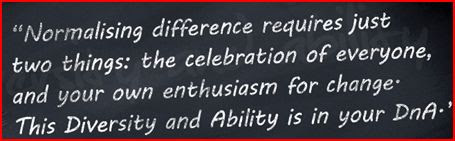


Now this is a good start.  Large font, not a white background.

Then we get into body of the website.

Welcome to DnA, a social enterprise story
designed and led by dyslexic and disabled
 adults working with the sole purpose to
 provide support, strategies, Assistive
 Technology training and shared wellbeing.
The website appears to be defaulted to Arial 10.5 font.  From work with dyslexic undergraduates in the UK the following histogram has been produced showing the ‘optimum font size, needed to stop the dyslexic student’s reading performance being limited by font size.


Ignore the pretty colours but look at the column on the left. 

There were 3 students who had a critical font (print size) less than 11!

In this histogram of the last 345 dyslexic students seen by my colleague, 99% would be restricted by the font size on the website.

Over half of them needed a font size of 16. They would still be restricted if the default was font 16.

This is in no way a new idea. Other studies have found a close relationship between font size and reading performance. One report suggested that font size management is a major reason for the popularity of Kindles, in addition to that lovely grey background.

In work being undertaken with a primary school, font size is the starting point in reducing barriers to reading. You can see a close link between oral reading fluency and critical print size. An adjustment that could be made in all printed materials at the school and in extreme cases using a computer screen.

I will publish this in Font 20 as well. There are issues in terms of restricting the space for advertising on the web… sorry to you graphics artists.

Back to the website.

Taking our cue from the expressed philosophy let’s consider accessibility. How can the user of the website reduce the barriers for themselves?
There is an accessibility option at the top of the site.  This gives the opportunity to raise the font to a massive Font 12!!!!!


Welcome to DnA, a social enterprise
 story designed and led by dyslexic and
 disabled adults working with the sole
 purpose to provide support, strategies,
Assistive Technology training and
 shared wellbeing.
                                                    
Ok that fantastic possibility will now bring improved access to…
..another 7% …..of the dyslexic adults reading this site, leaving another 92% struggling because of font size.
Mind you they probably think they are struggling because they are dyslexic!
I will quote someone who, on the occasions when I talked with him gave me great hope about what could be.
Attitude is indeed the biggest disablement. We all have the ability to change the attitude of others. ‘
Unfortunately that ‘attitudes’ that we strike up for ourselves; unwillingness to remove /reduce obvious boundaries restricts our ability to change the attitude in others.


I worked for a few years with a group of inspiring, severely physically disabled young people at Hephaistos School, when I first started teaching. They taught me a great deal.  First remove /reduce the barriers.  

And now at font 20

Font size.  Such an easy starting point to reduce barriers to reading. Critical Print Size

Yesterday I met the daughter of a friend who I taught with years ago. She always had difficulties in school, which were ‘diagnosed’ as Dyslexia when she went to the local FE College.

No one at school suggested that she may have a barrier to reading that could be reduced or removed.
The conversation which took place went over her experiences as a person growing up with dyslexia and how she was ‘assisted’.

She recounted how her difficulties got worse when she started in secondary school.  The drop in font size was a real problem for her. So much so that at the age of 12 she went to an optician where she was identified as significantly short sighted with an astigmatism in both eyes.

In secondary school, she did not like practical work which involved reading instructions or writing. She was very messy or clumsy if she mixed the practical work with reading and writing. This is a very typical story that I hear from adult dyslexic people.  Where possible she would work in a team and leave the reading and writing to other members of the team…. No problems then.

This did not solve her problem though.  In a way it must have reinforced in her the idea that she just was not really academic. The optician could not fix her problem.   She was still though very aware that the reading was really limited by the small font sizes being offered to her, in all the books and print outs.
With smaller fonts the letters seemed to crowd each other, especially the ends of the words, which she would guess at. After a short period of slow reading the letters and lines would start to move, become unstable.

At the FE College, she was referred to an Educational Psychologist, who duly tested her and pronounced her ‘dyslexic’. Unfortunately, she was unable to read the ‘report’ and did not understand the ideas when explained to her.  Again this is a common experience of dyslexic undergraduates.  It is often as if they do not recognise the report as really being about them.
Back to my friend’s daughter.

At the college the support staff went through ‘testing for ‘colour’. A range of ‘coloured plastic sheets’ were placed on to text.

Some stabilised the text for a short time, then the movement and crowding would start again. She has a ‘bluish filter’ which sort of helps sometimes.  But a larger font always does!

I am writing this today, after a few weeks without a blog following a spinal problem which has made it difficult to use my computer, because yesterday I received an email from a group of dyslexia specialists which I am a member of which included a link to a particular website.


Now the people who run this website are great people, I have tremendous respect for them. I have tried to engage them in a dialogue, but just get ignored. Perhaps they know something about me that I do not. Let’s consider the website, please look at it as you read this.

The first thing that hits you is the bit of graphics on the home page with the philosophy of the two main people at DNA and amongst others, that well respected ‘honourable /co-opted dyslexic Albert Einstein.


Now this is a good start.  Large font, not a white background.

Then we get into body of the website.

Welcome to DnA, a social enterprise story
designed and led by dyslexic and disabled
 adults working with the sole purpose to
 provide support, strategies, Assistive
 Technology training and shared wellbeing.
The website appears to be defaulted to Arial 10.5 font.  From work with dyslexic undergraduates in the UK the following histogram has been produced showing the ‘optimum font size, needed to stop the dyslexic student’s reading performance being limited by font size.


Ignore the pretty colours but look at the column on the left.  There were 3 students who had a critical font (print size) less than 11!

In this histogram of the last 345 dyslexic students seen by my colleague, 99% would be restricted by the font size on the website.

Over half of them needed a font size of 16. They would still be restricted if the default was font 16.

This is in no way a new idea. Other studies have found a close relationship between font size and reading performance. One report suggested that font size management is a major reason for the popularity of Kindles, in addition to that lovely grey background.
In work being undertaken with a primary school, font size is the starting point in reducing barriers to reading. 

You can see a close link between oral reading fluency and critical print size.  An adjustment that could be made in all printed materials at the school and in extreme cases using a computer screen.

I will publish this in Font 20 as well. There are issues in terms of restricting the space for advertising on the web… sorry to you graphics artists.

Back to the website.

Taking our cue from the expressed philosophy let’s consider accessibility. How can the user of the website reduce the barriers for themselves?
There is an accessibility option at the top of the site.  This gives the opportunity to raise the font to a massive Font 12!!!!!


Welcome to DnA, a social enterprise
 story designed and led by dyslexic and
 disabled adults working with the sole
 purpose to provide support, strategies,
Assistive Technology training and
 shared wellbeing.
                                
Ok that fantastic possibility will now bring improved access to…
..another 7% …..of the dyslexic adults reading this site, leaving another 92% struggling because of font size.

Mind you they probably think they are struggling because they are dyslexic!

I will quote someone who, on the occasions when I talked with him gave me great hope about what could be.

Attitude is indeed the biggest disablement. We all have the ability to change the attitude of others. ‘
Unfortunately that ‘attitudes’ that we strike up for ourselves; unwillingness to remove /reduce obvious boundaries restricts our ability to change the attitude in others.

I worked for a few years with a group of inspiring, severely physically disabled young people at Hephaistos School, when I first started teaching. They taught me a great deal.  First remove /reduce the barriers.

Monday, 3 June 2013

Dyslexia, Reading fluency, Colour, parafoveal processing and logic


This weekend I was talking with a relative who is also a teacher.  She told me that the new school she is working at was using colour overlays to help the pupils.

The school has a high proportion of students with ‘Special educational needs’.
They are aiming to get around 90% of their pupils into the 5+ GCSE grades ABC.  
 
Most SEN pupils have relatively low reading speeds, and there are good arguments to think that the low reading speeds are really about limited visual attention span, the number of letters that can be processed in parallel as they read. (see previous posts) or the number of milliseconds it takes to compute  the visual data this block of letters and others that are in the parafovea; how many letter can be processed within affixation…the perceptual span.

If this is true, and it is looking increasingly certain as more research comes out, then the gains that are experienced when using a coloured filter, has to be caused by.
  1. A decrease in the retinal data compute time … increased data transfer rate per millisecond
  2. Better spatial and temporal data integration as the ‘lines’ or edges’ move across the centre-surround arrangement of the cone cells of the retina; leading to reduced crowding effects.

Research into this is totally possible, but I do not have the resources. All published research seems to treat 'colour' as anything other than white or grey.

Usually 'red' , 'green',  'blue'  or yellow. With no real thought about the biochemistry of pigments and the metrics of pigment bleaching in the cone cells or the edge detection process.


My own work tells me that it is not actually really about ‘colour’ anyway.  Unfortunately, it requires a different mindset about ‘colour’ than appears to be dominant.

The filters that most schools use are from a very restricted palette. For example there is one cyan usually.  Cyan is not really a colour. It is what is perceived when the red cone stimulation is reduced compared with the green cone cells.

About half the population tested by my colleagues and me (from a sample of around 12,000) actually benefit from the use of ‘a cyan’.

But there are thousands of ‘cyans’; If the filter takes out too much red then it may be worse than a white background.

There may be other limiting factors not checked properly.

  • It may be that unless the font size is big enough, then the changing the amount of red will have no effect. It is not the controlling factor.

  • It may be that the ambient lighting is too bright and again the Cyan filter will have no effect.

  • Perhaps they need ophthalmic glasses first  to get any benefit.


The danger is that many young people at this school and other colleges and universities, will actually get minimal or no benefit when they could have got a great deal by teachers/schools/support staff not really understanding what they are doing.


A few will gain a great deal, and will be what spurs people on to use this very ‘cheap’ approach. Many, the majority, will get a ‘false negative’ and will have their failures reinforced.

 This costs them and our country a fortune unnecessarily.  The false negatives, and minimal benefits  that most children get is actually very expensive.

Saturday, 25 May 2013

A very important research article concerning the relationship between perceptual span and reading rate in adults.

This article by a team led by Keith Rayner, one of the world's leading researchers in this field, should be read by all seriously involved in working with dyslexic adults and anyone interested in how we read.

As in most research into reading, this looks at the reading performance of effective ‘fluent readers’. But it again reinforces the need for maximal parafoveal processing. Being able to process visually and hence phonologically, the characters in the direction you are reading.

The article refers to ‘fast’ and ‘slow’ readers.

The fast readers (reading over 258 wpm, with an average reading rate of 337 wpm with normally spaced fonts)

The slow readers (reading less than 258 wpm, with an average reading rate of 207 wpm with normally spaced fonts).

These must have been silent reading speeds, with I believe, most of the slow reading groups sub vocalising.

The slow reading group were unable to use of visual data more than one extra word in the direction of reading. Whereas the fast reading group were able to make use of 2, 3 or more words ahead.

Read the article. The evidence is very supportive of the model being developed here, which is mainly based on working for adults reading at an average speed of 134 words per minute, and very rarely over 160 words per minute. (See the previous post).

Think again about  of the relevance of particular numbers. 

For the slow readers, when they could only see the word they were reading,with no parafoveal visual information their mean reading speed dropped to that 160wpm again.  

For years, I used to have the number written large the wall where I was working. It always intrigued me.  So......
.......160 wpm is the mean reading speed if you can only visually/phonologically process one word at a time.

The majority of dyslexic adults, typically cannot process a whole word in one fixation. Research referred to in previous postssuggests this is likely to be associate to some extent with lack of phonological cues from parafoveal processing.

At least with the way text is usually presented.

An easy (and free way) way of finding out if you, your child,your friend or your student is likely to be diagnosed as dyslexic.


  1. The good reader sits beside the person to be checked, so that they both can see the printed body of text.
  2. The printed text is laid flat on a table.
  3. The person thought to be dyslexic reads aloud to the good reader.
  4. After approximately about 20 seconds, the good reader, as they hear a word being read places a finger across the next word to be read.

A reader who experiences difficulties, likely to be diagnosed as dyslexic, will stop reading.

Fluent readers will continue reading; they will already have visually and phonologically processed the covered word.

A really fluent reader will probably continue even if you cover up several of the words ahead of the one just heard.

All up to date models of reading, looking at the relationship between, linguistics, eyetracking  and reading performance, incorporate what is referred to as ‘word skipping’. This is the way in which the eyes do not have to bring every word to focus on the fovea in order to process it. But really this is about good, fluent readers.
 
The studies on which the models are based usually use data collected from fluently reading undergraduates, or occasionally fluently reading children.
When you look at eye tracking data, each eye fixation appears to take on average between 240ms and 300ms. (Between 3 and 4 per second)

When you measure reading aloud speed in adults, the mean for undergraduates is around 184 words per minute (this is also a clear mode). In my work this appears to be independent of what the words are. Random word sequences produce the same output and even random digit sequences. This was also found by Uta frith in her work with undergraduates at University College London. So I am in good company!

This is then quite a fundamental, important value.

But when this same group of people are reading silently, commonly people read around 480 words per minute ( this is a clear mode). BUT  the fixations still take the same amount of time. 2 to 3 words are being seen and processed in each fixation.


Another mode for reading aloud by adults is c160 words per minute. Many people who read aloud at around this speed also read silently at this speed.
This is all very mechanistic, there are mathematical patterns around. Wherever you find patterns in science, there has to be reasons, causation for the patterns.

The posts on visual crowding, parafoveal processing and parallel processing of visual data are all mechanistic biology helping to make sense of these patterns.

The post about musicians is highly pertinent. 
The fluent sight reading pianist turns the page well ahead of playing the notes on the page being turned.

The fluently reading teacher appears to be hardly glancing at the book as they read aloud to the children.


When we improve the processing of parafoveal and even peripheral visual data, by modifying its appearance, then we get more fluent phonological output.

Would covering up the next word still stop them reading?

Thursday, 23 May 2013

Parafoveal data collected during the ‘lexical access period’ (L1) of a word enables the phonological processing of the subsequent word.


Parafoveal data collected during the ‘lexical access period’ (L1) of a word enables the phonological processing of the subsequent word.

I have just read an article, the Urll is given below which is very supportive of the ideas developing in this blog.

Please read the article and if my interpretation is not correct please let me know.


The results suggest that the activation of phonological codes is a very early component of reading.

Suggests that phonological codes are associated with L1  time period.

So parafoveal data collected during the ‘lexical access period’ (L1)enables phonological processing which then enables the subsequent phonological processing of the following word, improving the ‘legibility’ ( Visual attention span increase)

This should enable faster fluent reading.

Any reduction of crowding in the parafoveal region should increase reading fluency with knock on effects on working memory/central executive.

This is of very great significance in the enjoyment and effectiveness of reading.  

Of major importance with adults who seem to have reached a limit totheir reading performance and are frustrated.

Tuesday, 21 May 2013

Why do dyslexic adults get so easily distracted especially when reading? Are they ADD or ADHD?


Why do dyslexic adults get so easily distracted especially when reading? Are they ADD or ADHD?

Three years ago I posted on the blog about the issue of ADD/AHDD

I have reposted it because, it is still very relevant and I believe should be read by more people.  Since then there has been a huge increase in the number of you reading the blog. You will have can see many graphs showing the binocular eye movements during reading in my other posts.
I hope this makes sense.
If it does, then please retweet the tweet you received informing you of this post. Thanks.
>>>>>> 
The other day, I met a little boy, 5 years old. He has been placed on medication after his school wanted to expel him. He has been diagnosed as ADD or ADHD.

Not sure which but one or the other. Taking the medication is the condition of his continuing in school.

He gave me a picture he had drawn; now framed and on my wall.
Ok. The medication leaves him calmer. But is that the only way? Why is he so easily distracted?

One of the characteristics of so many people when they are reading, is that one eye turns away from the page and ‘often gazes out of the window’ or goes ‘on patrol’ searching the environment for something that might need to be looked at…studied….checked out.

My Binocular Eyetracker shows me this eye turn happening with many dyslexic students, many of whom find concentrating when they are reading, extremely difficult. The dyslexic person does not 'feel the eye turn' although many do get eye aches associated with it after a few minutes of reading. This build up appears to be associated with reading stamina problems.

These students do not realise why, but if anything around them moves they stop seeing the words and instead, find themselves looking at whatever is moving! Or they turn their heads towards a new noise.

It was not until I was in Posnan, Poland, with the professor who was the developer of the Binocular Eyetracker that this all seemed to make sense.

He had a very simple way of demonstrating what was going on.
He used a ‘binocular viewer’, the old plastic ones where you looked at two very similar photographs, through two lenses, one for each eye. The two slightly different photos looked at like this gave you a 3-D image. Great fun in the 1950’s!

Professor Ober used an adjusted pair of photographs. One was a picture of an elaborate throne room in a castle. The other was a blank cyan (bluish) square.

When you looked through the viewer you only ‘saw’ the elaborate throne room, all reds and gold. Your brain completely ignores the cyan image. It suppresses it.

But he had adjusted the viewer in another way. In front of the cyan side was a tiny piece of wire. Which he could move as you viewed. When he did this your brain immediately switches attention to the blue side. You stop seeing the throne! After several seconds your brain ‘decides that the cyan is not interesting. ‘That eye is sort of switched off’ and your brain gives attention again to the throne!

Using the Eyetracker, you can see that the eye looking around the throne and the eye looking at the cyan were not looking at the same part of the two pictures. The eye looking at the cyan, has turned sideways slightly.

But as soon as the wire is moved, BOTH eyes move (called a saccade) move to the part of the picture where the wire has moved. It brings it to ‘centre stage’ focussed on your fovea or yellow spot. (The part of your retina which has the most ‘megapixels’ per square millimetre.)

Now if an eye us turned away from the target words, this is a reflex beyond your control. It is what we have evolved to do. It protects us from ‘dangerous things around us while we are concentrating. BUT when you are reading or concentrating for a long time it can cause great problems and in schools is seen as a fault. It is disruptive to others.

So let's return to the little boy. He has severe focussing problems; one eye is different to the other. He is very long sighted. He loves his glasses now he has them. They allow him to concentrate.

Many of the dyslexic adults I have seen have an eye which has been suppressed, often the eye needed but was not corrected by lenses when they were at school, in addition they were often very light sensitive and going with it ..Very easily distracted… With the reflex action described above, that is not really surprising!


Friday, 17 May 2013

How far has dyslexia come since the 1970s?


Steve McCue refers to the blog by Paul Ross.
Paul Ross asked the question in his blog. How far has dyslexia come since the 1970s? This was my response. What would yours be?
This is my response to Steve McCue’s response J

We still do not have an agreed single definition for dyslexia. There is too much focus on the medical model, our dyslexic brain is broken, we need to be cured and remediated deficit model of dyslexia.’
I agree with this statement. I do not think that this is a ‘fault’. We have created a society in which political and economic success is dependent for most people on the ease with which they can access text. Or rather the way that the text is presented to them in the text books, examinations, official forms etc.
Only two centuries ago in the UK, most people had few demands for literacy on them it hardly affected them. Then as printing got cheaper and we moved through industrialisation the control of literacy over people’s life chances really expanded and with it the need for literacy based education.
Before the general use of computers started to really develop about 20 years ago, this was always printed materials and the printers/publishers tailored the fonts and font size to match their markets.
The markets for reading material were those who could read effectively, small fonts and white backgrounds.
Different printed products were targeted at different markets.  For example, the ‘upmarket heavy newspapers, targeted at the ‘higher socioeconomic groups, who had been successful in school systems where the information was presented in small fonts on pages of crowded text.  For these people larger fonts would have been more difficult with fewer words ending upon each printed page. The newspapers and books would have been heavier and more paper needed.  In addition there had developed an association in the minds of the population that larger fonts were somehow ‘childlike’, suitable for people with low ability or visually impaired.
Newspapers targeted at an audience with a lower level of educational success....’The Tabloids’ used larger fonts, smaller sentences and less text/more pictures. The stories were and remain less intellectually demanding.
These ‘negative’ associations actually seem to inhibit adults from using a larger font even when they already know that they need it and despite experiencing difficulties with the usual small fonts,
The way that the small fonts also usually need high light intensity to process, also seems to have influenced the tendency to use whiter and whiter paper over the years.
The best readers usually seem to read best on the whiter papers, with the most contrast together of course with small fonts.
Most dyslexic adults who I know find the older books and papers with the darker paper easier to read from. The popularity of the Kindle, with its grey background may be partly accounted for by this.

The use of printed materials also makes the grey/white background ‘normal’. There was no choice. So really until around 1998 with Microsoft Word no one really studied in detail the effect of background.  Any consideration being through the use of coloured glasses or overlays from a limited palette. A very hit and miss approach with often confusing outcomes.
The computer screen allows very precise and objective measurement of any changes in reading performance.


Still too many dyslexic kids are being let down by an education system that fails to teach them in ways they can access the learning that takes place in schools.’
I find this an interesting perspective. Let’s avoid the term ‘dyslexic ‘for a moment and consider the way people who find reading difficult are let down.
When all text was presented printed on paper there was very little choice.  Ina previous post I have compared this as a similar situation to being a sportsperson in a world where only elastic size 8 shoes were available.
Different people would be the champions.  It would be a stupid world.  If your feet were smaller than 8, then you would get sore feet when you ran, would never run far, be very unwilling to train and never get really fit.
If your feet were larger than 8, you would squeeze in because of the elasticity but your speed and training would again be limited.
The great thing about a computer screen is that it is easy to fit the text to your eyes and your visual system, just like a shoe can be fitted to your feet.
This is a simplistic view of the situation but is valid way of thinking about the history of reading and reading difficulty.

It is not just about the eyes, it is the way the visual data is processed, limitations on that processing and then the way the associations between visual data and phonological data are processed. There are issues of working memory, auditory problems, phonological problems, possibly cerebellum problems, these will affect the efficiency with which the eyes collect the visual data on which the system is based, in that it is where the muscle tone controlling that collection is centred.  The work on the likely role of the Magnocellular system and its biochemistry and histology is central to both the visual data collection and its temporal and spatial processing, the way the information is coordinated and collated. The extent of demand on the central executive and its relationship with working memory, short term memory and long term memory; but we are only really in this 21st century just starting to make sense of all the components and the ways they interact.

Virtually all of the brilliant neurobiology research pertaining to reading that is going on now has only become possible because of the development of IT, computing and electronics.  We can now collect huge amounts of data and process it in seconds.  Before this era it was a slow laborious task. One world leading researcher I was talking with 10 years ago commented that he could probably conducted his lifetime of research in a few weeks if he had had a computer and modern electronics!
As our culture has become more and more dependent on text we make more and more literacy demands on each other. Virtually all employment requires functional literacy and better. In the last century, certainly before the 1980’s it was relatively easy to survive economically and educationally by avoiding text. Not true now.


‘There are still too many dyslexics in our prisons because they have been failed by the education system.’
I agree with this statement, although even when pupils are identified as dyslexic, most interventions in the past had any real benefit. Very few teachers had any idea what to do. Actually in Cambridgeshire in the 1970’s it was almost forbidden to use the word.  I was actually told off once for suggesting that a student might be dyslexic.  There seemed to be a fear that it might mean too much ‘money was needed to help’. In retrospect, many of the students who I am confident would have got more appropriate help now, were marginalised and I can imagine the temptations to be outside the law, in the way they were almost pushed outside of ‘society’

The review by Dr Michael Rice with Professor Greg Brooks of the NRDC (The National Research and Development Centre for Adult Literacy and Numeracy in the UK), published in May 2004 is the classic work on this subject.

‘Developmental dyslexia in adults: a research review’

This review was very badly received by ‘the dyslexia Industry’ when it was published... I recommend that everyone interested in this subject reads it with an open mind.
It is an exhaustive study which questions many of the ideas almost ‘faiths’ associated with dyslexia.
Myths are in a sense really concerned with the seeking of answers of understanding in an area which is complex and then feeling comfortable with the level of understanding you have reached. They involve rejection of ideas and people appearing to conflict with your own set of beliefs. These are subliminal rejection, not intentional but they help in reinforcing your own model or explanation of an idea such as ‘dyslexia’. Each person believes/knows that their ideas are the correct one. They know ‘the truth’.

‘There is still too much misinformation and too many incorrect myths surrounding dyslexia.’
Quite true. (I think!!).
The idea that boys are more clumsy and disruptive than girls and boys more likely to be dyslexic.
People who write letter reversals  b p, for example are more likely to be dyslexic.
Left handed people are more likely to be dyslexic
What is probably true is that these people are more likely to be ‘labelled as /diagnosed as dyslexic; in that anecdotally there appears to be an association with poor reading skills. Now that does appear to me to be true.  These people have other issues that result in them being ‘noticed’ as having problems

 ‘In most schools all dyslexic kids learn to be /are failures’.
They get marginalised, often, I think, because they cannot ‘perform’ at the level expected of them.
They get told off, but do not really understand why.
Slow, lazy, easily distracted, clumsy, messy and many other negative attributes.

‘I am dyslexic and a dyslexia specialist.....I believe that dyslexia is not a disability that it is a difference and that it is society that disables us. I believe in the social model of dyslexia. Dyslexia is a result of our evolution and as such reflects human diversity. Thus dyslexia is a difference not a disability. That all kids in school have the right to be learn and achieve according to their potential. This disabling begins in school where we are not taught in ways we can access the learning effectively. Of course there are some great dyslexia friendly schools, colleges and universities out there but they are far and few between.’
I actually agree closely with Steve on most of this but that is also true of many other disabilities.  A friend of mine, the late David Morris, was actively involved in disability rights throughout his adult life. Dave was because of physical disability, severely restricted in his mobility, but he saw his disability in terms of ‘barriers’ each of which needed reducing or removing to enable maximum access. He and colleagues and friends worked tirelessly to these ends. 
In the case of Dave, his disability had a clear medical/genetic origin. Dyslexia is a far more complex concept. In different countries and cultures the manifestation of the symptoms to some extent reflect the written language characteristics, alphabetic versus ideographic and in alphabetic languages, the extent of opacity, the extremes being such as Finnish ( Transparent ) English (Opaque) The research on the genetics associated with persons identified as dyslexic, reported at the Oxford-Kobe Symposium, demonstrated that this approach, was almost too complicated to utilise in barrier reduction, to a very large extent because ‘dyslexia’ itself as a ‘cobweb’ concept .In that  it manifests itself in so many ways, the phenotype is almost indefinable.
Let me give you two examples at the extreme.
1.    When I was teaching, I had the pleasure of working with a pupil, who at the age of 10 in the early 1980’s had been diagnosed as dyslexic by people at the Dyslexia Institute ( Now dyslexia Action). His mother who was financially limited struggled to pay for his attendance at weekly sessions to teach him ‘coping strategies’ and attempts to help him learn to spell, develop his working memory ( Kim’s Game  if I remember correctly)  Nothing seemed to have any effect.
At secondary school he was given extensive special needs support but from my knowledge NOBODY informed his teachers that he had been identified as dyslexic. Nobody went out of their way, as far as I or he remembered to remove or lower any barriers. What did happen was that his lively character, willingness to discuss, and argue got associated with all of the negative labels  experienced by most of the dyslexic students I see at universities He was marginalised, excluded repeatedly, but remarkably remained affable.
At no time did he remember support staff or dyslexia specialists ever suggest he have his vision tested. But then Dyslexia is nothing to do with vision...is it???????? He did have a ‘strange eye' though! Partly that caused him even more marginalisation
In 2001 I had just started to use the binocular eye tracker, We had worked out our original algorithm to optimise computer screens for students and I persuaded (not much was needed we had collaborated at the IOO) Anita Lightstone, the Low Vision chief at the Royal National Institute for the Blind (RNIB) to demonstrate what could be done in front of Prof Alistair Fielder a leading researcher associated with the RNIB.
I tracked down my ex-student and persuaded him to accompany me to London and be taken through the procedures in front of Professor Fielder and Anita. It was a matter of trust on his part. He did not know what I was going to do or why. A brave man, he was offered a trip to London and a good curry afterwards in exchange for his cooperation!
Eventually Prof Fielder did turn up and the demonstration began.
Let’s call my ‘guinea pig’...A….  On the eyetracker it was clear that one eye was totally suppressed, for whatever reason. His other eye was at most allowing the processing of two characters per fixation. The apparently wild movements of the suppressed eye appeared to be ‘tugging’ at the ‘good eye’ resulting in lots of head movement as he struggled to read.
At the conclusion of the optimisation both eyes were moving together and he was actually reading rather fluently much to his own surprise, and started to talk excitedly about what he had experienced.

The Professor dismissed the eyetracking information and the change in reading performance as being of no interest. ‘A’ stood up and in a very clear statement, which I will not report in full, turned to the Professor.
‘You might think it is of no interest but it is of ***************interest to me, reading has really ************   ** my life’; added a few more choice bits and stormed out to the Pub where I met him later.

Appropriate intervention to reduce /remove barriers had not been available to him before. Inappropriate intervention had been tried and reinforced his sense of failure and alienation.

2.     My second example concerns a mathematics student at a leading UK university, having attended a, very expensive, public school he had achieved 3 Grade A Advanced level grades.
He had had all the support his father could afford. He knew he was clever, he had been told so. The school had used every available way of minimising the barriers, with extra 1:1 tuition, extra time for his examinations, scribes when necessary. He was very articulate, very logical, an excellent mathematician. But if he had to read a block of text it was slow, faltering. He had had virtually no social life because it took him so long to read /study anything.
His father brought him into Westminster Access Centre 6o find out what we were going to do. An hour later, the student was laughing and reading fluently. He had a piece of ‘magic plastic’ and a setting for his computer screen. As a mathematician, he had followed the logic and he now felt in charge, empowered. His father sat there in disbelief and took out his calculator. After a few minutes his comment was.
‘I have spent over £45,000 on this in the last few years and this was it! A bit of plastic and a coloured computer screen!

Ok so these are two examples when what I do worked really well but it was only possible because of computers screens and the ability to calculate with millions of numbers in a few seconds. It would have been impossible to control the parameters controlling the image and calculate and analyse the outcomes without a computer.

But in the real world there is not equal access. With other ‘dyslexic’ people it may not work as effectively, there may be other factors that are limiting their reading performance that need dealing with as Steve says below.


‘Yes we have accessible technology that some dyslexics can use to enable them to overcome literacy barriers. But they are not a panacea and do not work for everyone. More to the point the high cost of this software makes it inaccessible in terms of cost for many dyslexics’.

As I wrote above not everyone gets access to accessible technology in addition some of the ‘accessible technology’ can be in itself be limiting..

An example here is text to speech technology. Learning is far more accessible if this is used in conjunction with maximised access to the text visually Visual processing assistance in conjunction with text to speech software would be synergistic.

If yo look at a lot of ‘accessibility options’ on computers they themselves are often written with very small fonts and are in themselves inaccessible. The instructions you get when you actually find them are often again, very complex and in small fonts excluding from the start many people who could make use of them.  We really need the default screen settings to be more accessible in the first place and easy to navigate. A better ‘User experience’!

In addition I rarely find any actual auditing of the benefits of much accessibility technology. It is a multi-million pound industry with a lot of ‘box-shifting’.

‘Yes dyslexia has a little higher profile now but in the main it’s a quite negative profile that focuses on what we do struggle to do. But we are just like everyone else out there in the non dyslexic world. We do struggle with some things but we can excel in others. Dyslexia is a difference not a disability and it’s a difference that needs to be embraced, nurtured and encouraged from day one in school.’
Now this makes absolute sense except that I actually think of dyslexia as being ‘many differences’ to take a word from my true love…biology …it is truly ‘polymorphic’!